
Introduction
You used to love what you do. You were motivated, focused, and proud of your work.
But lately? Getting out of bed feels like lifting a boulder. You go through the motions at work but feel nothing. Small tasks that used to take 20 minutes now take two hours. And no matter how much you sleep, you wake up just as empty as when you went to bed.
If this sounds like you — you are not lazy. You are not weak. You are burning out.
Burnout is one of the most misunderstood mental health conditions of our time. It is not just “being stressed.” It is a state of complete physical, emotional, and mental depletion caused by prolonged, unmanaged stress — and if you ignore the warning signs, it gets dramatically worse.
In this post, we cover the 10 clearest signs you are burning out, how it differs from regular stress, and the exact steps to start recovering today.
Burnout vs. Stress: What Is the Difference?
Before we get into the signs, it is important to understand what burnout actually is — because most people confuse it with stress, and treat it the wrong way.
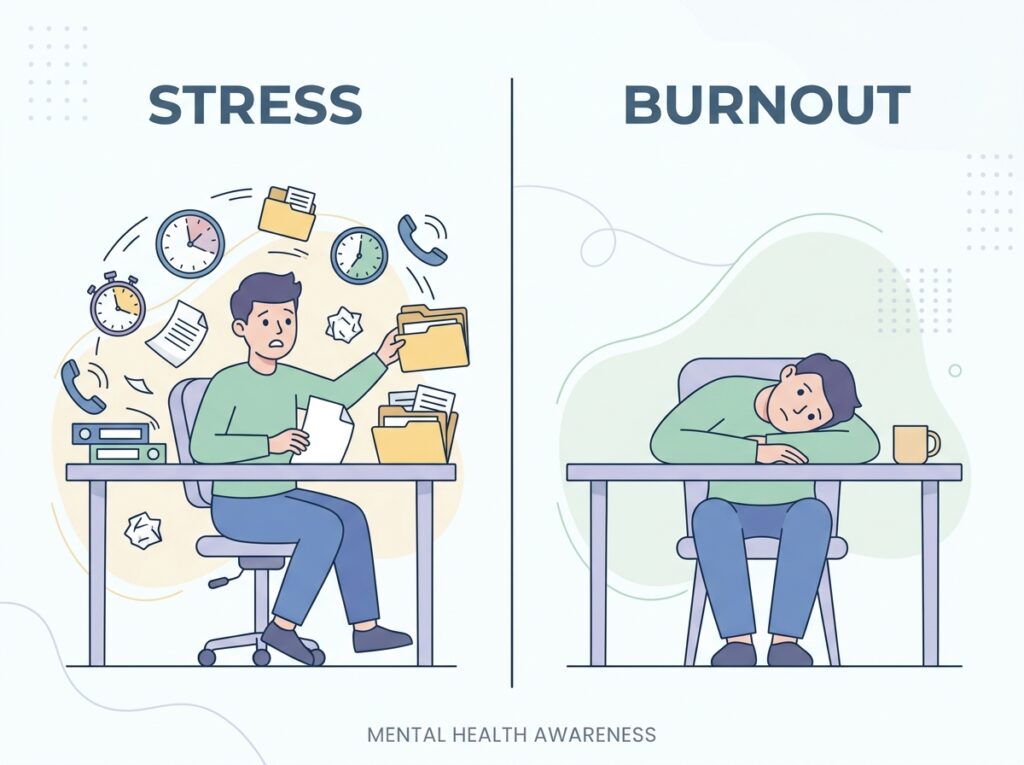
Stress feels like too much: too many responsibilities, too many demands. But there is still hope — you believe that if you just push through, things will get better.
Burnout feels like too little: no energy, no motivation, no hope. You are not overwhelmed — you are empty. The fire has gone out.
Stress can lead to burnout if it is ignored long enough. And here is the critical difference: while stress goes away when the pressure eases, burnout does not go away on its own. It requires intentional recovery.
10 Signs You Are Burning Out
Sign 1: You Are Exhausted No Matter How Much You Rest
This is the hallmark sign of burnout. You sleep 8, 9, even 10 hours — and wake up just as tired. The exhaustion is not in your body alone; it is in your soul. No amount of rest seems to touch it.
This happens because burnout exhaustion is not about sleep debt. It is about emotional and nervous system depletion. Your body has been running on stress hormones for so long, it has forgotten what recovery feels like.
Sign 2: Everything Feels Pointless or Meaningless
Work that once excited you now feels hollow. Goals you worked hard for suddenly seem not worth it. You find yourself asking “what is even the point?” more and more.
This loss of meaning — psychologists call it depersonalization — is a core symptom of burnout. It is your mind’s defense mechanism: it detaches you from pain by making you stop caring.
Sign 3: You Have Become Cynical and Irritable
Small things that never bothered you now drive you over the edge. You have become shorter with people you love. You find yourself being negative, sarcastic, or resentful — even when you do not want to be.
Burnout rewires your emotional responses. When your nervous system is chronically overtaxed, your brain’s ability to regulate emotions weakens. The result is irritability and a dark, cynical outlook that does not feel like you.

Sign 4: Your Productivity Has Collapsed
You are working longer hours than ever — but producing less. Simple tasks take enormous effort. You stare at your screen for an hour and accomplish nothing. You write one email and feel like you ran a marathon.
This is burnout brain fog: a real cognitive symptom where chronic stress degrades your working memory, focus, and decision-making ability. You are not being lazy. Your brain is running on empty.
Sign 5: You Have Stopped Taking Care of Yourself
Skipping meals. Not exercising anymore. Staying in bed all day on weekends. Ignoring messages from friends. Showering feels like a chore.
When you are burned out, self-care is often the first thing to go. You have no energy left for anyone — including yourself. This is a serious warning sign that the tank is not just low — it is empty.
Sign 6: You Are Getting Physically Sick More Often
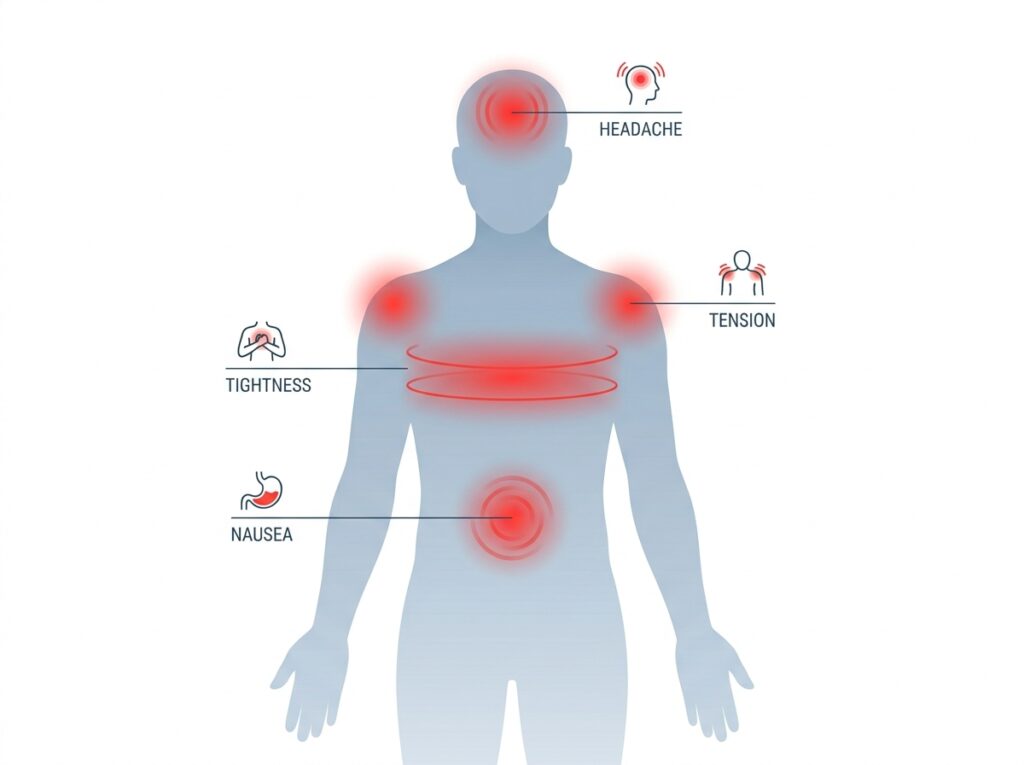
Burnout is not just mental — it is deeply physical. Chronic stress suppresses your immune system, leaving you more vulnerable to every cold, infection, and illness that comes your way.
Physical symptoms of burnout include:
- Frequent headaches or migraines
- Stomach problems (nausea, IBS-like symptoms)
- Muscle tension, especially in shoulders and neck
- Chest tightness or a feeling of weight on your chest
- Getting every seasonal illness that goes around
If you have been unusually sick lately with no clear medical cause, burnout may be weakening your immune defenses.
Sign 7: Sleep Does Not Help — And You Cannot Sleep Either
Burnout creates a cruel paradox: you are exhausted but cannot sleep properly. Or you sleep 10 hours and still feel tired. Both happen because of chronic cortisol dysregulation — your stress hormone cycle has been disrupted so badly that your body does not know when to wind down and when to wake up.
You might find yourself:
- Lying awake at night with racing thoughts
- Waking up at 3–4 AM and being unable to go back to sleep
- Feeling your heaviest and most tired in the morning, not at night
Sign 8: You Have Isolated Yourself from People
Social withdrawal is a red flag almost everyone misses. When burned out, even people you love start to feel like an energy drain. You cancel plans, ignore messages, and prefer to be alone — but being alone does not actually help you feel better.
This isolation feeds the burnout cycle. Human connection is one of the most powerful recovery tools — but burnout tricks you into avoiding it.
Sign 9: You Feel Like You Have Nothing Left to Give
This shows up strongly for caregivers, parents, teachers, healthcare workers, and anyone in a helping role. No matter how much you care about the people depending on you, you reach a point where there is simply nothing left. You go through the motions but feel completely hollow.
This is called compassion fatigue — a specific form of burnout that hits people who pour into others without refilling themselves.
Sign 10: You Have Lost Your Sense of Identity
One of the most distressing — and least talked about — signs of burnout is when you no longer know who you are outside of your work or responsibilities. You have been running so hard for so long that you have forgotten what you enjoy, what you value, and what makes you feel alive.
This happens when burnout has been severe and prolonged. It is not permanent — but it is a clear signal that recovery needs to start now.

What to Do When You Are Burning Out: 6 Recovery Steps
Step 1: Stop Pretending You Are Fine
Acknowledging burnout is not weakness — it is the only way to start getting better. Tell someone you trust. Say it out loud: “I am not okay right now.” This alone breaks the cycle of pushing through until you collapse.
Step 2: Remove or Reduce the Main Stressor
Burnout has a source. You cannot pour from an empty cup and just learn to pour faster. Something needs to change — a boundary at work, a responsibility you delegate, a commitment you cancel. Even a small reduction in the main stressor creates space to breathe.
Step 3: Protect Your Sleep Aggressively
Set a non-negotiable bedtime. Put your phone in another room. Make your bedroom cold, dark, and quiet. Sleep is the foundation of every other recovery strategy — nothing else works well without it.
Step 4: Do One Small Enjoyable Thing Every Day
Not a vacation. Not a spa day. Just one small thing that has zero productivity attached to it — a 15-minute walk, a chapter of a book, cooking something you like. Pleasure is medicine for a burned-out brain.
Step 5: Reconnect with One Person
One honest conversation with a friend, family member, or therapist can interrupt the isolation spiral. You do not have to explain everything. Just show up and be present with someone who cares about you.
Step 6: Consider Professional Support
If your burnout has been going on for months, or if you are experiencing symptoms of depression alongside it, please talk to a mental health professional. Therapy — especially Cognitive Behavioral Therapy (CBT) — has strong evidence for treating burnout and preventing relapse.
Quick Burnout Self-Check
Ask yourself these 5 questions honestly:
| Question | Yes / No |
|---|---|
| Do I wake up dreading the day ahead? | |
| Has my motivation dropped significantly in the last month? | |
| Do I feel emotionally numb or detached from things I used to enjoy? | |
| Am I more irritable or cynical than usual? | |
| Does rest not seem to help my exhaustion? |
If you answered Yes to 3 or more: You are likely experiencing burnout. Start with Step 1 above and consider speaking to a doctor or therapist.
When to See a Doctor or Therapist
See a professional if:
- Burnout symptoms have lasted more than 4–6 weeks
- You are experiencing hopelessness, persistent sadness, or thoughts of self-harm
- Your physical health is clearly declining (frequent illness, chest pain, extreme sleep disruption)
- You cannot function normally at work or at home
Burnout left untreated can develop into clinical depression and anxiety disorders. Early professional support saves months of suffering.
Want to learn more articles on Health:
Final Thoughts
Burning out does not make you weak. It makes you human. It means you have been giving too much for too long without enough coming back in.
The signs are your body and mind waving a white flag — not telling you to give up, but telling you to slow down before you are forced to stop completely.
Start today. Rest without guilt. Set one boundary. Tell one person how you really feel.
Recovery is not dramatic. It is quiet, consistent, and absolutely possible.